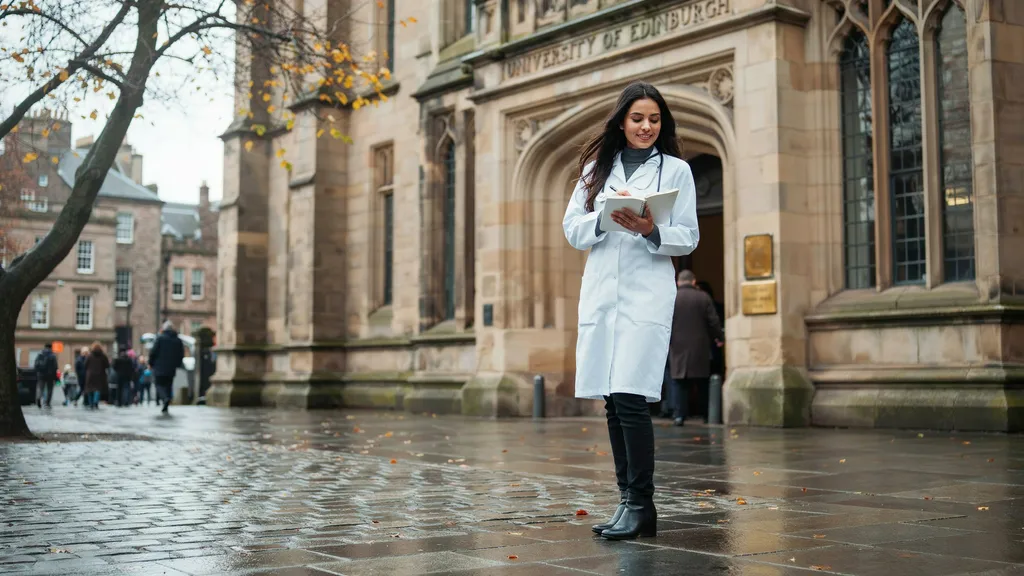
Ishita lived in Ahmedabad. She scored 95 percent in Class 12 with Chemistry and Biology. She wanted a British medical degree but every site quoted a different fee. One said GBP 30000 a year and another said GBP 70000. She searched for how to Study Medicine in UK 2026. No single clear answer appeared.
She then built one table. She listed each school’s fee and course length and entry test. She added living costs and the visa rule. The total became clear. This guide follows her method to Study Medicine in UK 2026.
Study Medicine in UK 2026: Quick Answer
International fees start near GBP 30150 a year at Leicester. Cambridge charges GBP 70554. Those are 2026/27 rates from a list updated on 7 September 2026. Most courses run five years. Oxford and Cambridge and Imperial and UCL run six. Living costs add GBP 13500 to 17800 a year.
Entry needs AAA or better with Chemistry and Biology. Most schools need the UCAT. International places are capped near 7.5 percent at public schools. A five year degree at a lower fee school costs about GBP 2.2 lakh. That is the core of how to Study Medicine in UK 2026.
How We Built the List
We used a fee list for international medical applicants updated on 7 September 2026. It gives 2026/27 fees for every UK medical school. Fees marked from rise in clinical years. We added entry rules from school pages and visa rules from the UK Home Office.
Fees for 2027/28 were not published when the list was updated. Expect a rise of a few percent. Use this as a map to Study Medicine in UK 2026. Confirm the current fee on each school’s page before you apply.
Lower Fee Medical Schools
Twelve schools charge under GBP 47500 a year. Leicester and Birmingham start near GBP 30000. Southampton and Warwick start near GBP 32000. Warwick is graduate entry only. St Andrews and Manchester sit near GBP 40000.
Study Medicine in UK 2026: Lower Fee Schools (theukcatpeople.co.uk updated 7 September 2026)
| Medical school | Course and length | International fee per year (2026/27) |
|---|---|---|
| University of Leicester | MBChB 5 years | From GBP 30150 |
| University of Birmingham | MBChB 5 years | From GBP 30330 |
| University of Southampton | BMBS 5 years | From GBP 32000 |
| University of Warwick (graduate entry) | MBChB 4 years | From GBP 32510 |
| University of St Andrews | MBChB 6 years | GBP 39620 |
| University of Manchester | MBChB 5 years | From GBP 39900 |
| University of Sheffield | MBChB 5 years | GBP 45310 |
| Cardiff University | MBBCh 5 years | GBP 45450 |
| University of Bristol | MBChB 5 years | GBP 45800 |
| Newcastle University | MB BS 5 years | GBP 47000 |
| University of Leeds | MBChB 5 years | GBP 47000 |
| University of Nottingham | BMBS 5 years | GBP 47000 |
The from figure means the fee rises in clinical years. Budget for GBP 5000 to 10000 more in years three to five. Lower fee schools still deliver a GMC registered degree. Study Medicine in UK 2026 does not require a famous name. They anchor the budget route to Study Medicine in UK 2026.
Higher Fee and Top Ranked Schools
The best known schools charge GBP 49400 to 70554 a year. Cambridge adds a college fee of about GBP 11500 to 15000. Oxford adds a college fee too. Imperial and UCL run six years in London. Glasgow charges GBP 62730 in Scotland.
Study Medicine in UK 2026: Higher Fee and Top Ranked Schools
| Medical school | Course and length | International fee per year (2026/27) |
|---|---|---|
| University of Oxford | BM BCh 6 years | From GBP 49400 plus college fee |
| Queen Mary University of London (Barts) | MBBS 5 years | GBP 49950 |
| University of Liverpool | MBChB 5 years | GBP 50000 |
| University of Edinburgh | MBChB 6 years | GBP 54650 |
| King’s College London | MBBS 5 years | GBP 56800 |
| University College London | MBBS 6 years | GBP 57300 |
| Imperial College London | MBBS 6 years | GBP 58600 |
| University of Glasgow | MBChB 5 years | GBP 62730 |
| University of Cambridge | MB BChir 6 years | GBP 70554 plus college fee of about GBP 11500 to 15000 |
A six year Cambridge degree can pass GBP 5 lakh. That includes college fees and living costs. Imperial and UCL pass GBP 4.5 lakh. Rankings matter less for a GMC licence than applicants think. Weigh prestige against cost when you Study Medicine in UK 2026.
Entry Requirements
Most schools ask for AAA to A*AA at A-level with Chemistry and Biology. Indian applicants usually need about 90 percent in Class 12 with PCB. The UCAT is required by most schools. IELTS 7.0 to 7.5 is standard. UCAS allows four medicine choices with a mid October deadline.
Study Medicine in UK 2026: Entry Requirements
| Requirement | Typical standard | Notes |
|---|---|---|
| A-levels | AAA to A*AA with Chemistry and Biology | Some schools accept one science plus Maths or Physics |
| Indian Class 12 | About 90% and above with PCB; varies by school | Check each school’s India page |
| UCAT | Required by most UK schools; sit it the summer before applying | Cambridge and some others also interview heavily |
| English | IELTS 7.0 to 7.5 overall with no band below 6.5 to 7.0 | Or equivalent accepted tests |
| UCAS application | Deadline mid October the year before entry; four medicine choices | Personal statement replaced by structured questions from 2026 entry |
| Interview | MMI or panel at most schools | Work experience and reflection matter |
| International cap | About 7.5% of places at most public schools | Competition is intense; apply strategically |
From 2026 entry UCAS replaced the personal statement with three structured questions. Interviews use the MMI format at most schools. Work experience in healthcare helps. The international cap of about 7.5 percent makes places scarce. Apply strategically to Study Medicine in UK 2026.
The UCAT Explained
The UCAT is a two hour computer test. It covers verbal reasoning and decision making and quantitative reasoning and situational judgement. It runs from July to September the year before entry. International centres include India. Scores are valid for one admission cycle only. Study Medicine in UK 2026 means sitting it in 2025 or resitting.
Most schools set a cut-off or use the score in ranking. A strong score opens interviews. A weak score closes doors regardless of grades. Prepare for three months with timed practice. The UCAT is the first gate to Study Medicine in UK 2026.
The Full Cost Picture
Add tuition and living costs and the health surcharge and flights. The UK visa requires proof of GBP 1483 a month in London. Outside London it is GBP 1136. Both apply for nine months. The immigration health surcharge is GBP 776 a year. Flights and insurance add more.
Study Medicine in UK 2026: Full Cost Picture
| Cost item | Yearly estimate | Basis |
|---|---|---|
| Tuition at a lower fee school | GBP 30000 to 40000 | 2026/27 published fees |
| Tuition at a top ranked school | GBP 50000 to 70000 plus college fee | 2026/27 published fees |
| Living costs outside London | About GBP 13500 (visa rule GBP 1136 a month for 9 months) | UK student visa maintenance requirement |
| Living costs in London | About GBP 17800 (visa rule GBP 1483 a month for 9 months) | UK student visa maintenance requirement |
| Immigration health surcharge | GBP 776 a year | UK Home Office rate |
| Five year total at a lower fee school outside London | About GBP 2.2 lakh (roughly ₹2.5 crore) | Fees plus living costs |
| Six year total at Imperial or UCL in London | About GBP 4.6 lakh (roughly ₹5.3 crore) | Fees plus living costs |
A five year degree at a cheaper school outside London costs about GBP 2.2 lakh. That is roughly ₹2.5 crore. A six year London degree at Imperial or UCL totals about GBP 4.6 lakh. Those totals define the budget to Study Medicine in UK 2026.
Top 5 Picks by Priority
Study Medicine in UK 2026 depends on what you value. These five picks match a priority to a school. They use the fee and course data above.
Study Medicine in UK 2026: Top 5 Picks by Priority
| Student priority | Pick | Why |
|---|---|---|
| Lowest fee from a public school | Leicester or Birmingham | From GBP 30150 to 30330 a year |
| Graduate entry in four years | Warwick | From GBP 32510 and four year course for graduates |
| Top ranked with large London hospitals | Imperial or UCL or King’s | GBP 56800 to 58600 but deep clinical exposure |
| Historic six year science heavy route | Oxford or Cambridge | GBP 49400 to 70554 plus college fee |
| Scotland at mid price | St Andrews or Aberdeen | GBP 39620 to 50100 with smaller cohorts |
1. Lowest Fee From a Public School: Leicester or Birmingham
Leicester starts at GBP 30150 and Birmingham at GBP 30330 for 2026/27. Both run five year MBChB courses. Both are large research universities with teaching hospitals. Fees rise in clinical years.

The saving against London schools passes GBP 1 lakh over five years. These are the value picks to Study Medicine in UK 2026.
2. Graduate Entry in Four Years: Warwick
Warwick runs a four year MBChB for graduates only. The fee starts at GBP 32510. Applicants need a prior degree and usually the UCAT. The shorter course saves a year of fees and living costs.
Indian graduates with a science degree fit this route. This is the graduate pick to Study Medicine in UK 2026.
3. Top Ranked With Large London Hospitals: Imperial or UCL or King’s
Imperial charges GBP 58600 and UCL GBP 57300 for six year MBBS courses. King’s charges GBP 56800 for five years. All three sit beside major London teaching hospitals. Clinical exposure is deep and research options are wide.
London living costs are the highest in the UK. These are the prestige picks to Study Medicine in UK 2026.
4. Historic Six Year Science Heavy Route: Oxford or Cambridge
Oxford starts at GBP 49400 and Cambridge at GBP 70554 plus college fees. Both run six years with a science intercalation built in. Entry is the most competitive in the UK. Interviews are academic and demanding.
Only the strongest profiles should apply. These are the elite picks to Study Medicine in UK 2026.
5. Scotland at Mid Price: St Andrews or Aberdeen
St Andrews charges GBP 39620 for a six year route. Students transfer to a partner school for clinical years. Aberdeen charges GBP 50100 for five years. Cohorts are smaller and living costs are lower than London.
Scotland suits students who want a quieter campus. These are the Scottish picks to Study Medicine in UK 2026.
After Graduation: Licence and Visa
UK graduates enter the two year Foundation Programme. GMC registration follows the first year. The Graduate visa lets international graduates stay to work after the degree. The government announced a cut from two years to 18 months for later applicants. Check the current rule. Study Medicine in UK 2026 with that change in mind.
Indian graduates who return home must clear the NMC licensing exam. FMGE remains the exam in 2026. A UK degree is well regarded but still needs the test. Plan both paths when you Study Medicine in UK 2026.
For wider context see the World Economic Forum section on health and healthcare systems. The OECD health page offers comparative data on doctors and training. Both add background to how to Study Medicine in UK 2026.
5 Costly Mistakes Applicants Make
Mistake 1: Ignoring the From Figure
A fee marked from rises in clinical years. Budget GBP 5000 to 10000 more per year later.
Mistake 2: Skipping UCAT Preparation
A weak UCAT score closes interviews. Prepare for three months with timed practice to Study Medicine in UK 2026.
Mistake 3: Choosing Four London Schools
London fees and living costs are the highest. Mix one or two lower fee schools into your four choices.
Mistake 4: Forgetting the Visa Maintenance Rule
The visa needs proof of nine months of living costs plus fees. Arrange funds early.
Mistake 5: Assuming Direct Practice in India
A UK degree still needs the NMC exam to practise in India. Plan for it when you Study Medicine in UK 2026.
Action Plan: How to Study Medicine in UK 2026
Step 1: Check Grades and Subjects
Confirm Chemistry and Biology at A-level. Indian applicants need PCB in Class 12 with 90 percent or more.
Step 2: Book and Prepare for the UCAT
Register in spring. Sit it by September. Practise for three months.
Step 3: Pick Four Schools by Fee and Fit
Mix lower fee and top ranked schools. Check each school’s international page.
Step 4: Apply by Mid October
Submit the UCAS form with structured answers. Prepare for MMI interviews.
Step 5: Arrange Funds and Visa
Collect fee and living cost proof. Pay the health surcharge. That completes your plan to Study Medicine in UK 2026.
Also read: MBBS Abroad for Indian Students 2026: Cheapest Countries and Fees
Frequently Asked Questions
Q1: How much does it cost to study medicine in the UK for international students?
Tuition starts near GBP 30150 a year at Leicester for 2026/27. Cambridge charges GBP 70554. Most schools charge GBP 45000 to 50000. Cambridge and Oxford add college fees. Living costs run about GBP 13500 outside London by the visa rule. London is GBP 17800. The health surcharge is GBP 776 a year. A five year degree at a cheaper school outside London costs about GBP 2.2 lakh. A six year London degree can pass GBP 4.6 lakh. Study Medicine in UK 2026 therefore costs roughly ₹2.5 crore to ₹5.3 crore in total. Fees rise most years. Confirm the current figure on each school’s page.
Q2: Which UK medical school is cheapest for international students?
Leicester at GBP 30150 and Birmingham at GBP 30330 are the cheapest public schools. That is for 2026/27. Southampton starts at GBP 32000 and Warwick at GBP 32510 for graduate entry. St Andrews charges GBP 39620 and Manchester starts at GBP 39900. These from figures rise in clinical years. All deliver a GMC registered degree. Study Medicine in UK 2026 at a cheaper school saves more than GBP 1 lakh. That is over five years against London. Study Medicine in UK 2026 on a budget starts here. Living costs outside London are lower too. Entry standards remain high everywhere. Apply to a mix of schools to improve your odds.
Q3: What are the entry requirements for medicine in the UK?
Most schools ask for AAA to A*AA at A-level with Chemistry and Biology. Indian applicants usually need about 90 percent in Class 12 with PCB. The UCAT is required by most schools. IELTS 7.0 to 7.5 overall is standard with no band below 6.5 to 7.0. UCAS allows four medicine choices with a mid October deadline. From 2026 entry three structured questions replace the personal statement. Interviews use MMI at most schools. Healthcare work experience helps. International places are capped near 7.5 percent at public schools. Study Medicine in UK 2026 demands strong grades and UCAT and interview. Prepare all three.
Q4: Is the UCAT compulsory?
Most UK medical schools require it. A few use alternative routes or their own assessments. The UCAT is a two hour computer test. It covers verbal reasoning and decision making and quantitative reasoning and situational judgement. It runs July to September the year before entry. Test centres exist in India and many countries. Scores are valid for one cycle only. Schools set cut-offs or rank by score. A strong score opens interviews. Study Medicine in UK 2026 starts with UCAT preparation in spring. Practise with timed mock tests for three months. Register early because centres fill. Check each school’s page for how it weighs the score.
Q5: How long is a UK medical degree?
Most undergraduate courses run five years. Oxford and Cambridge and Imperial and UCL and Edinburgh and St Andrews run six. Graduate entry courses at Warwick and Swansea and others run four years. After graduation comes the two year Foundation Programme. GMC registration follows the first foundation year. Specialty training then takes three to eight years. Study Medicine in UK 2026 is a long path. Budget for the full undergraduate span plus living costs. Six year courses add about GBP 70000 to the total. The extra year includes a science intercalation. Decide whether that suits your goals before you choose a school.
Q6: Can Indian students practise in India after a UK MBBS?
Yes after passing the NMC licensing exam. FMGE remains the exam in 2026. NExT has been notified but not applied to foreign graduates. A UK degree is well regarded and covers the syllabus deeply. Graduates still need to sit the exam and complete any required internship under NMC rules. Check the current regulation because it changes. Study Medicine in UK 2026 therefore suits students who may work in the UK first. Many stay for the Foundation Programme and then decide. Keep every document from the UK course. The GMC registration certificate helps with later applications. Plan both paths from the start.
Q7: Can I stay and work in the UK after the degree?
Yes through the Graduate visa and then a skilled worker route. The Graduate visa lets international graduates stay after the course. The government announced a cut from two years to 18 months for later applicants. Check the current rule before you plan. Medical graduates usually enter the Foundation Programme which sponsors a visa. Doctors are on the UK shortage list so sponsorship is common. Study Medicine in UK 2026 therefore offers a clear work path. The NHS employs most new doctors. Pay starts near GBP 36000 to 38000 in foundation year one by recent scales. Confirm the current figure with the NHS pay page.
Q8: What living costs should I plan for?
The UK visa needs proof of GBP 1483 a month in London. Outside London it is GBP 1136. Both apply for nine months. That is GBP 13344 in London and GBP 10224 outside as the minimum. Real costs often run higher over a full year. Budget about GBP 17800 in London and GBP 13500 elsewhere. Add the health surcharge of GBP 776 a year. Add flights and insurance and books. Study Medicine in UK 2026 outside London saves about GBP 4000 a year. Student housing in halls costs GBP 6000 to 12000 a year. Part time work is limited to 20 hours a week in term. Keep a buffer for currency moves.
Q9: How competitive is admission for international students?
Very competitive. Public schools cap international places near 7.5 percent. A school with 300 places takes about 22 international students. Thousands apply. Strong grades and a strong UCAT and a strong interview are all required. Study Medicine in UK 2026 rewards a balanced application to four schools. Mix one top ranked school with lower fee schools. Check each school’s international admissions statistics. Some private schools such as Buckingham sit outside the cap. Apply early and prepare for MMI interviews. Study Medicine in UK 2026 needs a plan B too. Work experience in healthcare and reflection on it matter. A gap year with experience can strengthen a second attempt.
Q10: Are scholarships available for medicine in the UK?
Few and small. Most medical schools offer limited international scholarships of GBP 2000 to 10000 a year. Some offer merit awards at entry. Full scholarships for undergraduate medicine are rare. Education loans from Indian banks cover UK medical degrees at many lenders. Check collateral rules and the bank’s university list. Study Medicine in UK 2026 mostly runs on family funds and loans. Apply for school scholarships at the same time as admission. Check deadlines on each school’s funding page. Graduate entry students sometimes find more funding. Keep documents ready for scholarship forms. Ask the international office directly. Study Medicine in UK 2026 rarely comes free so plan the loan early.
Conclusion
Study Medicine in UK 2026 costs GBP 30150 to 70554 a year in tuition. Living costs add GBP 13500 to 17800. A five year degree at a lower fee school totals about GBP 2.2 lakh. A six year London degree can pass GBP 4.6 lakh. Entry needs top grades and the UCAT and an interview.
Check your subjects. Prepare for the UCAT. Pick four schools by fee and fit. Apply by mid October. Arrange funds and the visa. That is how to Study Medicine in UK 2026.
This guide on how to Study Medicine in UK 2026 is general information. It is not admission or immigration or financial advice. Fees and rules change every year. Confirm all details with the medical school and the UK Home Office before you apply.